Next Token Prediction (NTP) has long been the dominant training method for LLMs. However, the Multi-Token Prediction (MTP) approach is gaining increasing traction among researchers, driven by two main reasons:
- Improved model quality: Research shows that MTP achieves better results on a range of tasks, such as planning and code generation.
- Faster inference: If a model generates 10 tokens in a single forward pass, the theoretical speedup can approach 10x (in practice the gain is smaller, but the number illustrates the potential).
However, a key challenge of MTP remains the assumption of token independence during parallel generation. Tokens are most commonly generated in parallel by different transformer heads, which requires heuristics (e.g. speculative decoding) to compensate for inter-token dependencies. For instance, the authors of [5] attempt to work around the independence problem, though there is clearly still room for improvement.
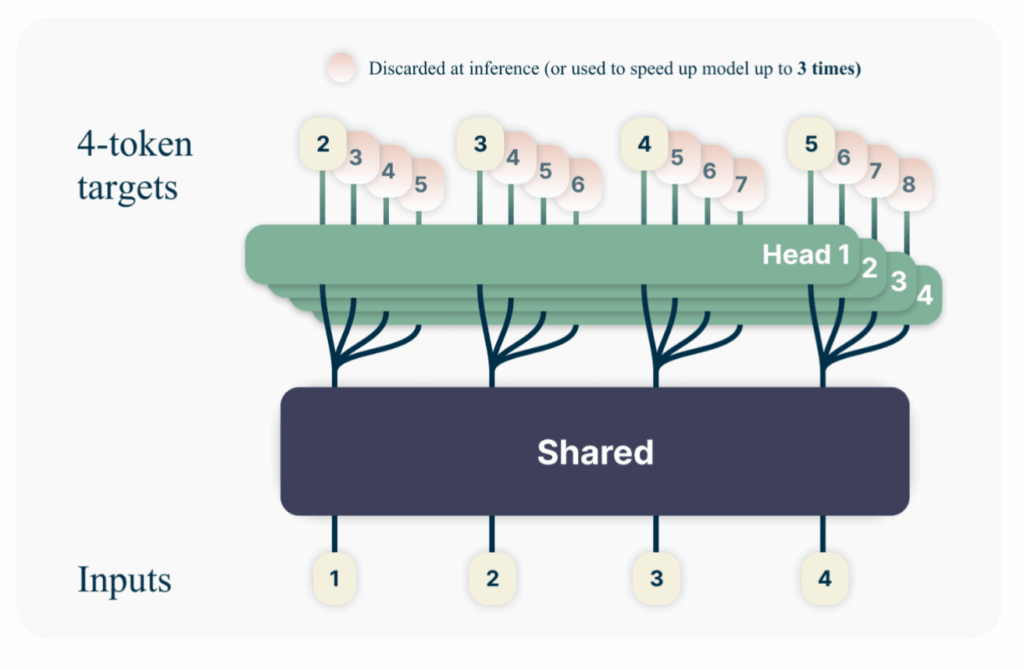
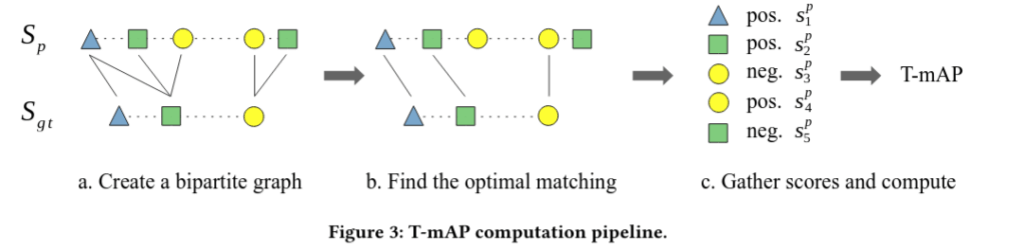
Figure from [8].
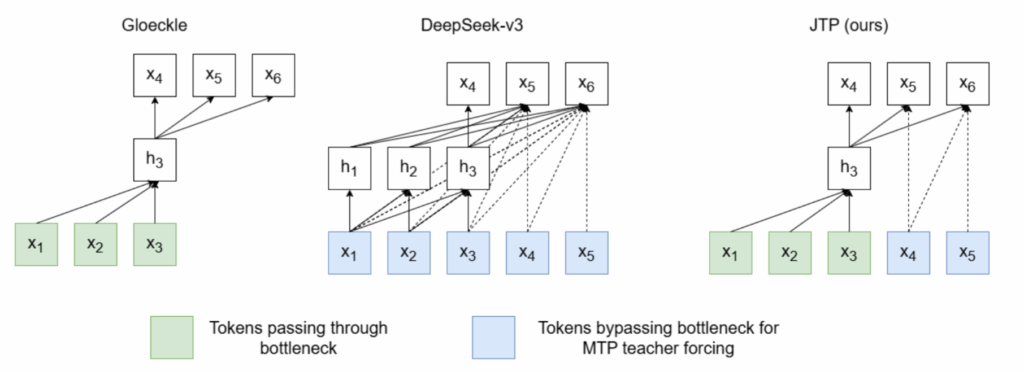
Figure from [5].
Teacherless Learning represents an intermediate approach between NTP and MTP — in some sense the opposite of teacher-forcing. For example, when generating the word ABUNDANCE, after the character A, instead of feeding in the actual next characters, the model inserts the placeholder > three times in a row:
0: A >
1: AB
2: AB >
3: ABU >
4: ABUN
…
Unlike MTP, Teacherless Learning has a rigorous mathematical foundation. While it does not speed up inference, it exposes fundamental shortcomings of traditional NTP.
Work [7] shows that NTP with teacher-forcing struggles with tasks requiring long-range dependency prediction (e.g. Path-Finding on Path-Star Graphs). The authors of [6] state directly:
«Teacherless training and diffusion models comparatively excel in producing diverse and original output».
Interestingly, diffusion models — which are rapidly gaining popularity — also generate groups of tokens jointly, and notably show strong performance on code-related tasks.
Against this backdrop, adapting existing models to MTP is emerging as a promising research direction for resource-constrained settings.
References:
[1] On multi-token prediction for efficient LLM inference
[2] Ideas in Inference-time Scaling can Benefit Generative Pre-training Algorithms
[3] Multi-Token Prediction Needs Registers
[4] Improving Large Language Models with Concept-Aware Fine-Tuning
[5] Efficient Joint Prediction of Multiple Future Tokens
[6] Roll the dice & look before you leap: Going beyond the creative limits of next-token prediction
[7] The Pitfalls of Next-Token Prediction
[8] Better & Faster Large Language Models via Multi-token Prediction
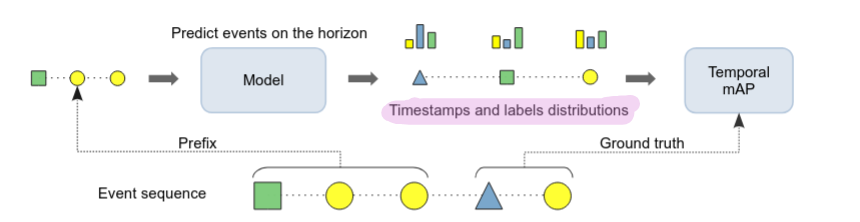
 — essentially dividing the time interval into buckets of size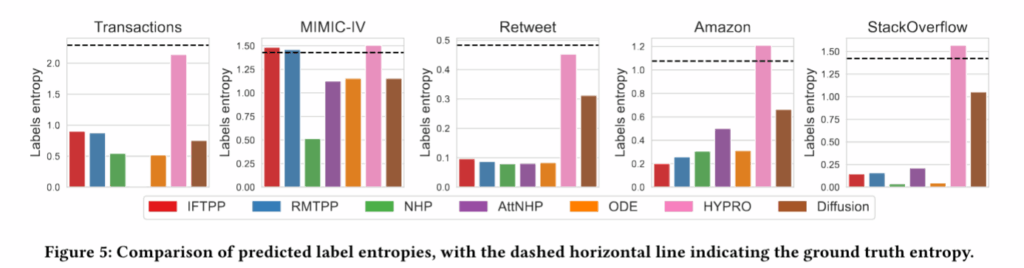

 ,
, ,
, .
.